Several decades after the Massachusetts Bay Colony was settled, John Foster, a young engraver and printmaker in Boston, carved the woodcut used to produce the first published map of the English Colonies in North America, according to the Library of Congress.
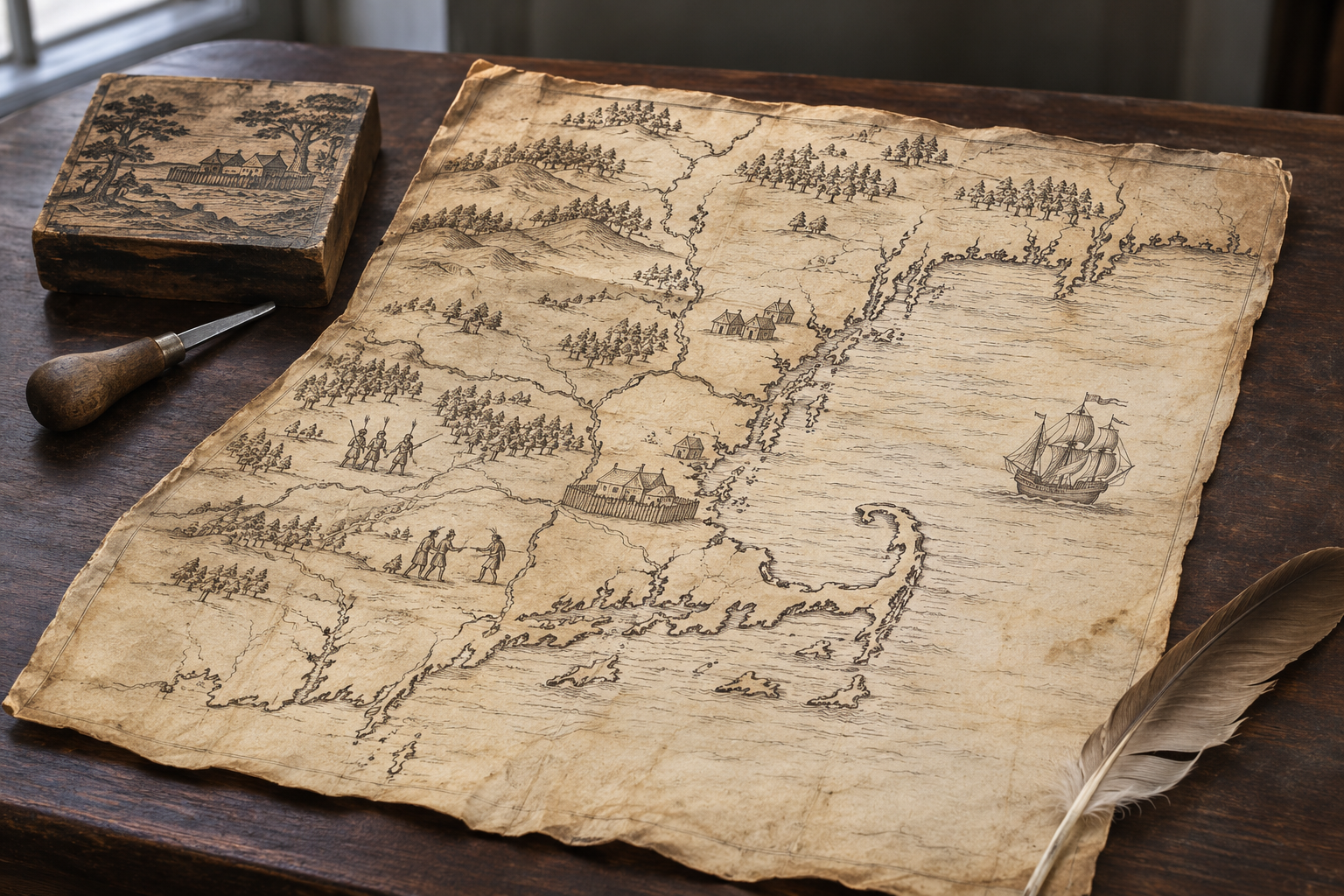
Foster’s “A Map of New England” appeared in a 1677 book about the continuing battles between Colonists and the region’s tribal nations known as King Philip’s War or Metacom’s War. Sometime afterward, though the precise date remains uncertain, an unidentified person created a pen-and-ink copy of the printed map. That enigmatic reproduction is now held by the Library’s Geography and Map Division.
Rather than offering a complete representation of New England’s geography, the map chiefly serves as a visual overview of the war’s best-known armed confrontations and the English Colonists’ territorial claims. Even so, it depicts significant features from the period, including Indigenous lands, Colonial settlements, rivers and coastlines.
The Library says its copy is significant both for its unknown origins and for the period practice it documents. By the late 17th century, only a small number of printing presses operated in the Colonies, making hand-drawn maps by far the most prevalent way to portray the region’s landscapes. A handwritten annotation across the reproduction’s top identifies it directly: “This is a copy of the first map engraved in New England.”
Below that annotation, the copy reproduces the original map’s unusual orientation. Western New England is positioned at the top in both versions, while the northern territories appear on the right. The inscriptions, mountains and numerous trees also correspond one-to-one.
The Library suggests the unidentified copyist may have become less motivated toward the end of the work. Foster’s more elaborate woodcut contains several images absent from the reproduction, including sailing vessels, two people emerging from the woods and figures at the outer edges that appear to depict a fox and a bear.
Subscribe to the Library of Congress blog— it’s free!
Based on an article published by Library of Congress by Neely Tucker · Read the original ↗