
The Basic Concept Behind Automatic Mowing
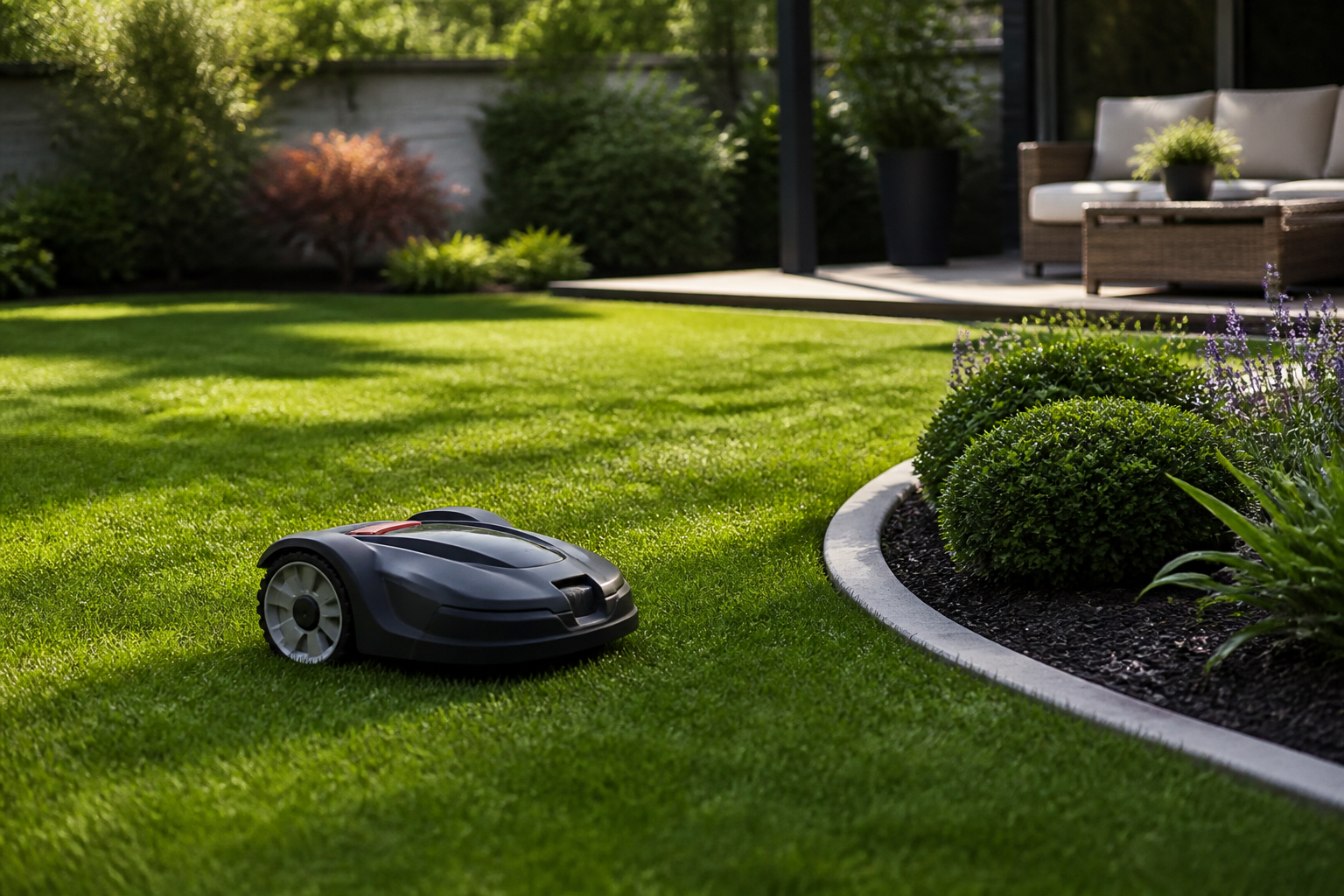
At its core, a robotic lawnmower operates on a fairly simple principle. Instead of mowing the entire lawn in one go and then letting it grow for weeks, the device regularly, often daily, traverses small sections of the lawn, trimming off only a few millimeters of grass at a time. This method is gentle on the lawn while ensuring a uniform, well-groomed appearance, all without requiring any manual effort on your part.
This approach differs significantly from traditional mowing, where a large amount of grass is typically cut all at once, usually on a weekly basis. To understand how robotic mowers work compared to conventional machines, it is therefore important to keep this distinction in mind, as it explains many of the other technical design choices.
Navigation Without Visible Lines
One of the most intriguing questions surrounding robotic lawn mower technology is likely how the devices actually know where the lawn ends and where they should not go. In the past, this usually required a thin boundary wire buried in the ground around the lawn; the robot would detect the signal and automatically stay within the designated area.
More modern models increasingly rely on camera systems, GPS support, or a combination of multiple sensors, thereby eliminating the laborious process of laying cables. Many devices from Lymow are being developed with precisely this approach in mind, aiming to minimize setup effort for users without compromising reliability.

Sensors and Obstacle Detection in Detail
For an autonomous lawn mower to operate safely, it needs more than just an idea of where the lawn ends. It must also detect when an obstacle suddenly appears in its path—whether it is a toy, a tree branch, or a pet crossing the lawn. Various sensors are used for this purpose, such as bump sensors, ultrasonic sensors, or optical systems, depending on the model and price range.
When the robot encounters an obstacle, it typically stops immediately, changes direction, and continues working elsewhere. It is precisely this interplay between sensors and software that distinguishes a device that simply moves stubbornly in a straight line from a truly well-designed autonomous lawn mower capable of adapting to its surroundings.t line from a truly well-designed autonomous lawn mower capable of adapting to its surroundings.

How Garden Navigation Actually Works
Another key aspect of how robot mowers work is the actual navigation across the lawn. Some models follow relatively random patterns; while this may appear chaotic at first glance, it ensures that the entire lawn is mowed evenly over the course of several days. Other units, usually higher-end models, plan their routes more systematically, much like a robot vacuum in a living room.
This systematic navigation can be particularly advantageous for larger or more complex garden layouts, as it minimizes instances of overlapping coverage or missed areas. Therefore, when choosing a model, it is worth considering how the specific robotic lawn mower technology handles navigation within your own garden.
Charging and Routine Maintenance
One practical aspect that is often overlooked is energy management. Most robotic lawnmowers automatically locate their charging station when the battery runs low and resume mowing from where they left off once charged. This process takes place entirely in the background, meaning users rarely need to attend to the device.
Maintenance requirements are also minimal for most models; usually, it suffices to occasionally clean or replace the blades and check the sensors for dirt. It is precisely this combination of low effort and reliable performance that makes devices like those from Lymow so appealing to many garden owners and people who want a well-groomed lawn but do not wish to spend time maintaining it every weekend.
A Brief Look At the Future of This Technology
The technology behind robotic lawnmowers continues to evolve rapidly. Improved sensors, smarter software, and easier setup, eliminating the need for boundary wires, are among the areas that have seen the most significant advancements in recent years. If you are wondering how robotic lawnmowers will operate in the future, you can expect them to become even more autonomous and user-friendly.
Ultimately, there is a great deal of sophisticated technology behind the seemingly simple image of a small robot moving across the lawn. Those interested in exploring this topic, “how do robot lawn mowers work,” can further find valuable insights into current developments at Lymow and gain a clearer understanding of how modern garden maintenance works today.