Vietnam Veteran’s long search returns POW/MIA bracelet to fallen Air Force captain’s son
According to VA News, an unexpected package arrived by mail at the West Palm Beach VA Healthcare System on Sept. 11, 2026. It contained a silver bracelet bearing the name “Dennis Wilkinson” and the date “5-10-72.”
The package arrived exactly 48 years after U.S. investigators identified the remains of U.S. Air Force Capt. Dennis Wilkinson, returning part of his story to the place where it began.
Born in West Palm Beach, Florida, on July 23, 1944, Wilkinson married another native of the city, and the couple had two children. He learned to fly while attending the University of Florida and later entered the Air Force from his hometown. During the Vietnam War, he served with the 13th Tactical Fighter Squadron.
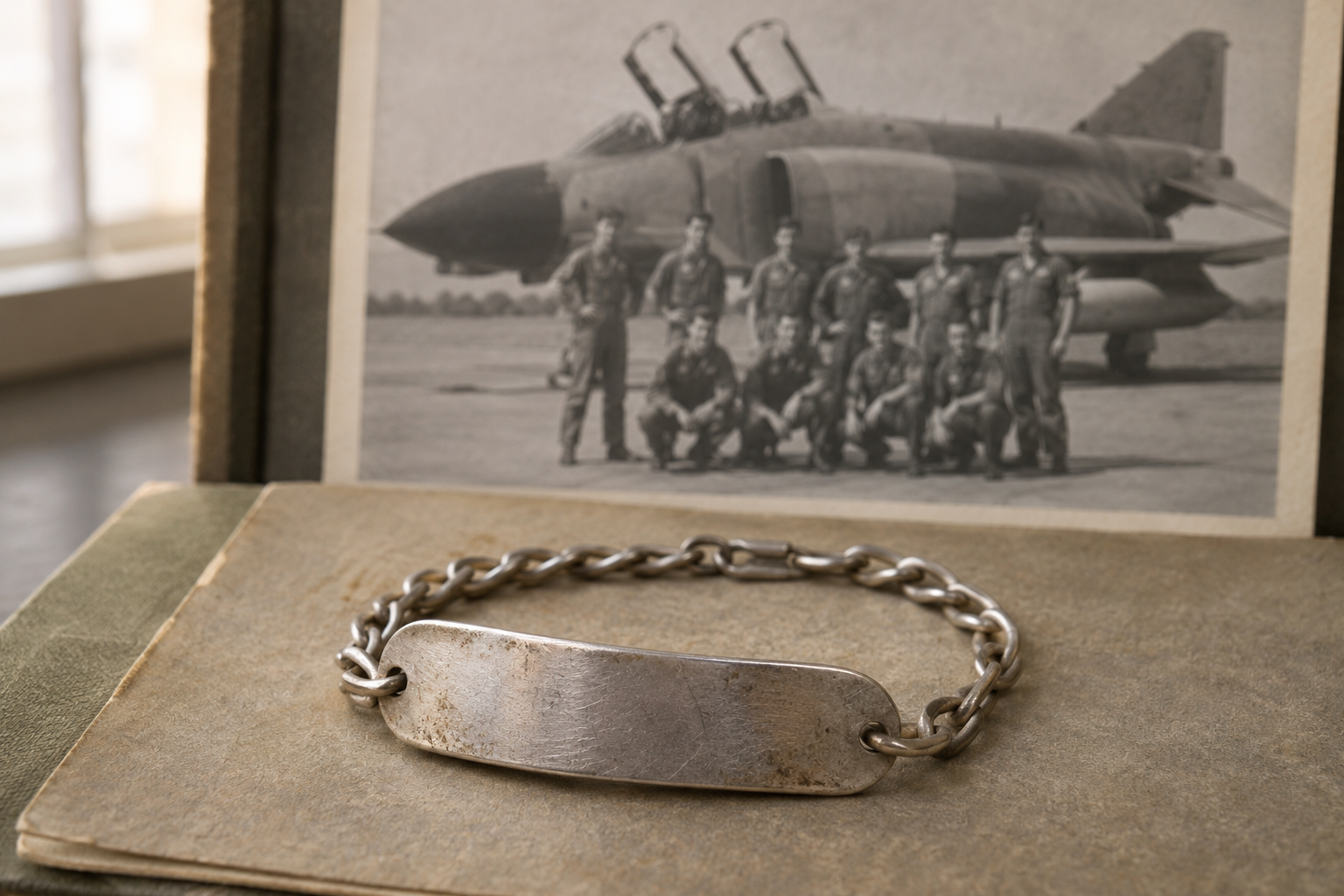
Wilkinson was the weapon systems officer aboard an F-4E Phantom II during a combat mission over North Vietnam on May 10, 1972. Enemy fire struck the aircraft, which crashed in Vinh Phu Province.
His remains could not be recovered then, and he was listed as missing in action. Officials initially thought he might have survived the crash and become a Prisoner of War. Wilkinson was not among the American prisoners released in February 1973, however, and none of those released had information about him.
The Vietnamese government repatriated wartime remains in 1978. U.S. investigators identified Wilkinson’s remains on Sept. 11 of that year.
Wilkinson is now memorialized at the Courts of the Missing at the National Memorial Cemetery of the Pacific. His name is also inscribed alongside those of fallen comrades on the Vietnam Veterans Memorial Wall in Washington, D.C.
A bracelet preserved and remembered
For years, the silver bracelet honoring Wilkinson remained with Mark Kramer, an Army Vietnam Veteran and former commander of an American Legion post in Green Lake, Wisconsin.
Kramer no longer recalls how the bracelet came to the Legion post he led. He does remember concluding that it should not be thrown away or allowed to be forgotten.
His efforts to find Wilkinson’s family included contacting military and Veterans organizations and pursuing connections as far away as Florida. None of those inquiries produced a match or a useful lead.
Kramer recently chose to send the bracelet to West Palm, hoping that someone at the VAMC might have more success locating Wilkinson’s relatives.
Effort to find the family
Once the bracelet arrived, members of the West Palm Beach VA Healthcare System’s Privacy, Chaplain and Communications offices began searching. VA News said staff reviewed records, placed telephone calls, sent letters and coordinated outreach before ultimately reaching Douglas Wilkinson.
Douglas was very young when his father died. Much of his later understanding of his father came from family stories and photographs preserved over the years. Those accounts portrayed a man devoted to his family who enjoyed the outdoors and sought adventure. One family story involved his parents’ unreliable Dodge Dart breaking down, after which his father bought his mother a Pontiac LeMans for Valentine’s Day in 1969.
“That car’s part of the family,” Douglas said. “I got that car from my mom when I was 15 and I still have it.”
As Douglas grew older, relatives including his grandfather and uncle helped him develop a fuller picture of his father.
“He became that surrogate figure,” Douglas said of his grandfather. “He was basically my granddad and dad.”
Douglas’s uncle remembered his older brother as supportive and someone who helped keep him from getting into trouble.
Military service also ran through the Wilkinson family. One of Douglas’s grandfathers served as an Army Air Corps bomber pilot, while the other was a Navy submariner. His mother was a civilian employee of the Department of Defense. Douglas spent his childhood near Eglin Air Force Base, and even his youth soccer coach had served as a military aviator. Douglas later served as well.
A connection to his father comes home
VA News reported that the bracelet’s return carried a distinct meaning for Douglas because it showed that another person had carried his father’s name.
“There’s some strength in community for other people remembering,” he said.
Learning that a fellow Vietnam Veteran had safeguarded the bracelet made that community connection even more meaningful to him.
“He took the time and effort and energy not only to hang on to this, but, as information and technology changed over time, to keep trying to track down where it needed to go,” Douglas said. “It causes you to rethink all of those things and pulls all those memories back to the forefront. You get so caught up in the day-to-day stuff that you forget about some of the things that are important.”
Douglas now considers how his children will remember the grandfather they never had the chance to know. When he lived near Washington, D.C., he took them to Arlington National Cemetery and other memorial locations twice each year—on his father’s birthday and on the anniversary of his loss.
Receiving the bracelet also prompted Douglas to consider bringing his family together again, possibly at Thanksgiving, so they could exchange stories and create additional memories.
“Life is about the connections we make,” he said. “And there is a real concern that our memories will fade.”
Douglas said that outlook influences his own relationships. He sees himself as the person who makes the call, purchases concert tickets and looks for opportunities to reunite longtime friends, much as the bracelet brought part of his father’s life back into the present.
A remembrance tradition shaped by legacy
The return of Wilkinson’s bracelet reflects a broader tradition of remembering those who served.
During the Vietnam War, POW/MIA bracelets became one of the most recognizable means by which Americans honored prisoners of war and military personnel missing in action. Each bracelet linked its wearer with a particular service member, carrying that individual’s name beyond relatives and a military unit into communities around the country.
VA News said the principle behind that tradition continues to matter to Douglas decades later.
He hopes those who hear his father’s story understand that names appearing on bracelets and memorials represent real people who made difficult decisions while serving others.
“They’re good people, and they do things that are hard,” he said. “As long as there are people willing to stand up and protect the things that are important to them, I think we still have a pretty bright future.”
More than five decades after Dennis Wilkinson flew his final mission, the bracelet inscribed with his name finished a journey of its own. It traveled from an unidentified wearer to another Vietnam Veteran in Wisconsin and, eventually, to Wilkinson’s son in West Palm Beach.
VA says it provides benefits to eligible former prisoners of war and members of their families. Eligibility and service information is available through Benefits for former prisoners of war.
Based on a VA News news release by Nikki Verbeck · Read the original ↗