President Lai Ching-te received a joint delegation headed by Vice President of the French National Assembly Marie-Agnès Poussier-Winsback on the morning of November 20, Taiwan Office of the President reported. The group included National Assembly deputies and representatives of the French telecommunications regulatory authority. According to the office, President Lai thanked the French parliament and government for what he described as their longstanding, concrete support for Taiwan. He said Taiwan would keep strengthening its self-defense capabilities and whole-of-society defense resilience while cooperating with democratic partners to protect peace and stability in the Indo-Pacific. He also voiced hope for deeper Taiwan-France cooperation on undersea cable protection and risk management, as well as institutionalized cooperation to promote bilateral investment and R&D and develop more secure and robust democratic supply chains.
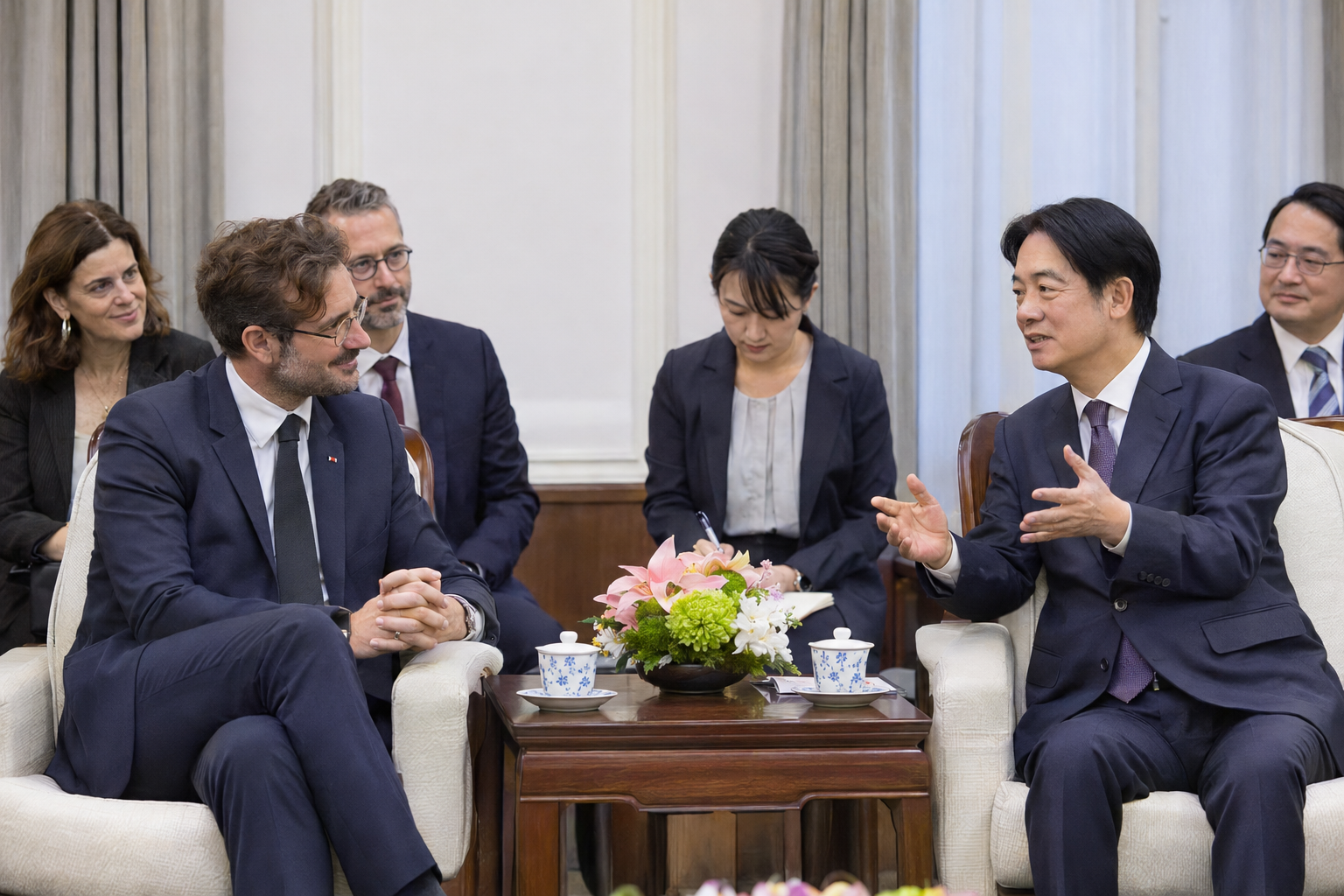
Welcoming the delegation, President Lai recalled exchanging views at length in May with a group led by the chair of the French National Assembly's Taiwan Friendship Group. He said he was pleased to receive Vice President Poussier-Winsback and her delegation at the Presidential Office. In his assessment, the joint visit by parliamentarians and representatives of the French telecommunications regulatory authority reflected the depth of Taiwan-France friendship and could create new opportunities for cooperation.
President Lai expressed gratitude to the delegation members for speaking in support of Taiwan over many years. He said his state visit to Taiwan's ally, the Kingdom of Eswatini, was temporarily placed on hold in April after China pressured third countries to cancel permits for Taiwan's charter flight. He particularly thanked Taiwan Friendship Group Vice Chair Éric Martineau, Foreign Affairs Committee Secretary Estelle Youssouffa, and other supporters in the National Assembly for backing what he called Taiwan's freedom to engage with the world.
The president maintained that Taiwan has the right and ability to participate in international affairs and contribute globally. He thanked the French parliament and government for actions he characterized as supportive of Taiwan. As one example, he cited the joint statement from the Group of Seven (G7) foreign ministers' meeting in Paris this month, which reaffirmed opposition to unilateral attempts to alter the status quo through force or coercion and expressed support for Taiwan's meaningful participation in international organizations. President Lai reiterated that Taiwan would enhance its self-defense capabilities and whole-of-society defense resilience and work with democratic partners to safeguard Indo-Pacific peace and stability.
President Lai also linked the preservation of peace to the security of critical infrastructure. He said undersea cables from Europe to the Taiwan Strait had repeatedly faced deliberate sabotage in recent years. In response, he noted, Taiwan proposed the RISK Management Initiative on International Undersea Cables, which has received co-signed support from parliamentarians in numerous European countries. He said the initiative was intended to help protect essential communication and energy-transmission links. With the delegation's support, he expressed hope that Taiwan and France could expand cooperation on cable protection and risk management and jointly improve the resilience of international cable infrastructure.
Describing France as Taiwan's third-largest trading partner in the European Union, President Lai said bilateral cooperation was continuing to grow in fields ranging from semiconductors, electric vehicles, and renewable energy to space technology. He called for institutionalized cooperation to encourage bilateral investment and R&D and strengthen democratic supply chains. He also said Taiwan sought a closer partnership with France in technology and democratic experience, with both sides acting in support of freedom, democracy, and respect for human rights while pursuing greater prosperity for their countries.
Vice President Poussier-Winsback subsequently thanked President Lai for receiving the delegation despite his busy schedule and for extending a warm welcome. She observed that some delegates were making their first visit to Taiwan while others had returned, and said all had experienced Taiwan's hospitality and learned about its culture, resilience, economy, and development in numerous fields. She also described the delegation's discussions with several Taiwanese government officials as in-depth and friendly, saying they illustrated the warm relationship between the two sides. She added that the delegates would continue efforts to deepen Taiwan-France friendship after returning to France.
Vice President Poussier-Winsback said France remained committed to maintaining peace across the Taiwan Strait and would continue regularly and clearly stating its opposition to any unilateral alteration of the status quo and to force, threats of force, and coercion. She said France communicated this stance domestically and through European and multilateral channels, including in the recent joint statement by G7 foreign ministers. She added that official and parliamentary exchanges were helping Taiwan and France pursue concrete cooperation on shared concerns, including countering information manipulation and reinforcing economic resilience.
She further stated that France wanted to deepen its economic and trade relationship with Taiwan. Characterizing France as the EU's economic engine and a key entry point to the EU market, she noted that French investment in Taiwan had risen steadily in recent years. She expressed hope that additional Taiwanese businesses would invest in France and use it to expand further into the European market.
Vice President Poussier-Winsback said France highly valued Taiwan's democracy and wished to use that foundation to strengthen cultural, educational, and scientific cooperation. She noted that France had supported the Taiwan Global Pathfinders Initiative promoted by President Lai by hosting several Taiwanese youth groups. Their exchange visits covered areas including space policy, soccer, sports for persons with disabilities, and technology. She also welcomed the continued expansion of city-to-city exchanges beyond Taipei, saying they were encouraging cooperation in culture, the arts, and education.
Concluding her remarks, Vice President Poussier-Winsback said a recent visit to Taiwan by a delegation from Mayotte had allowed the two sides to outline future cooperation between Taiwan and Mayotte. She described France's scientific research capabilities as highly complementary to Taiwan's industrial strengths and encouraged Taiwanese companies and investors to consider opportunities in France's startup sector to deepen bilateral technological cooperation. On behalf of the delegation, she again thanked President Lai for receiving the group.
Other delegation members were France's Regulatory Authority for Electronic Communications, Postal Affairs and Press Distribution Chairwoman Laure de La Raudière and National Assembly Deputies Charlotte Parmentier-Lecocq, Belkhir Belhaddad, and Anne-Cécile Violland. French Office in Taipei Director Frédéric Laplanche accompanied the delegation to the Presidential Office.
Based on a Taiwan Office of the President news release · Read the original ↗