5 min read
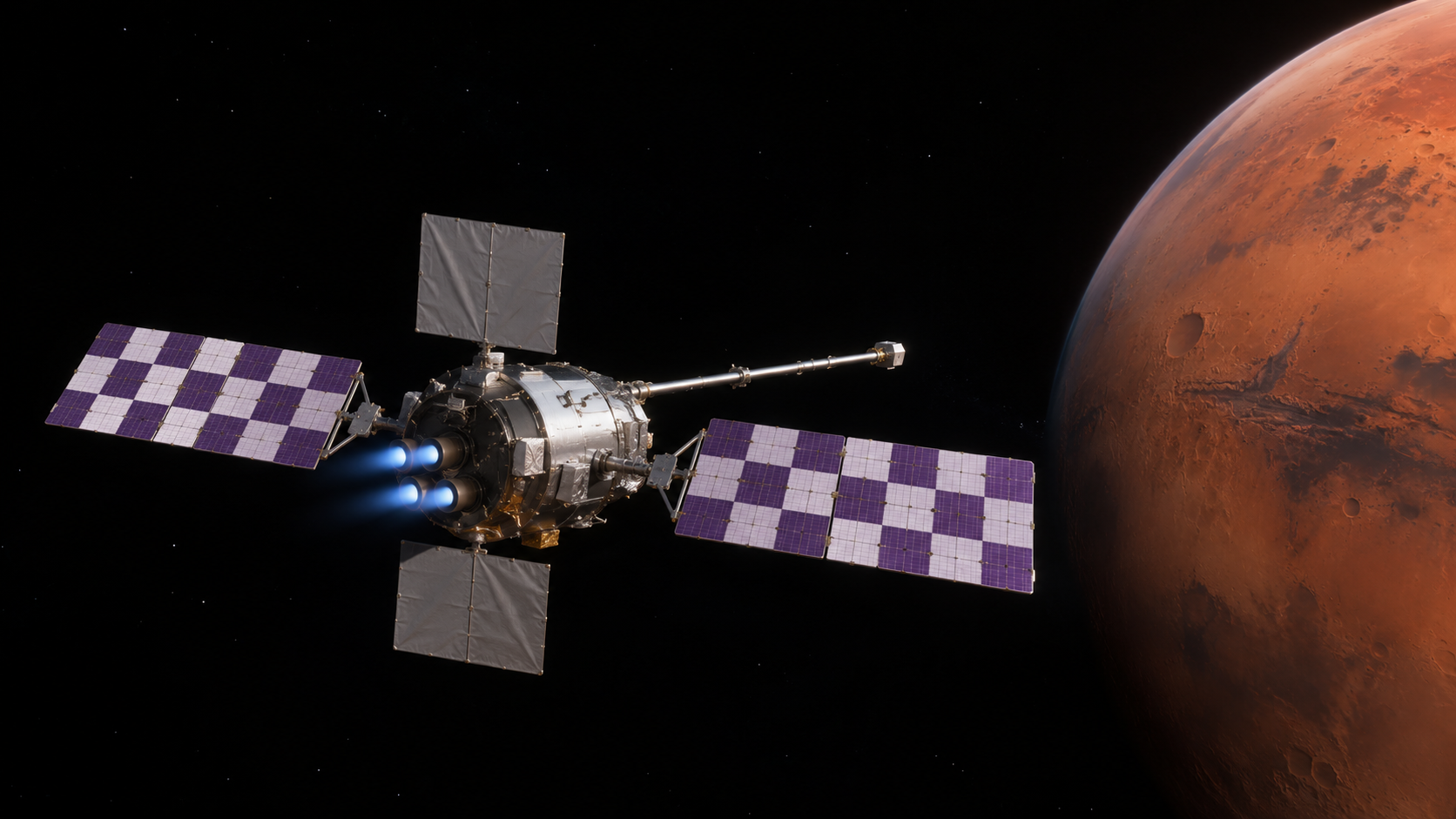
NASA said it has completed a major review of Space Reactor-1 (SR-1) Freedom, establishing key elements of the spacecraft. The mission is targeted to launch in 2028 and demonstrate nuclear electric propulsion in deep space for the first time.
Experts from NASA, the U.S. Department of Energy (DOE), and industry convened at NASA’s Glenn Research Center in Cleveland in October for a major review of the SR-1 mission design. According to NASA, several important decisions made during the meeting moved the mission beyond its early concept phase and toward a defined spacecraft design.
“SR-1 marks a pivotal step in how we travel through the solar system,” said Steve Sinacore, SR-1 Freedom program director. “This mission will be the first freight run on the railroad of the solar system, and the decisions we’re making now are laying the tracks for every nuclear-powered spacecraft that follows.”
SR-1 is planned for launch in late 2028 and will draw on nuclear and solar power to transport SkyFall to Mars. The capsule will carry three next-generation helicopters. After deployment, the helicopters are expected to examine Martian geology and climate history, investigate new terrain, and look for indications of subsurface ice.
NASA said more ambitious exploration missions will demand substantially more power for future spacecraft and surface operations than present systems can supply, especially where sunlight is scarce or absent. The agency expects SR-1 to show how fission power could support long-duration missions, prepare the way for dependable surface power systems serving NASA’s future Moon Base, and make exploration farther into the solar system possible.
Key design decisionsThe design of the SR-1 Freedom spacecraft has changed since NASA Administrator Jared Isaacman unveiled the concept in March at the agency’s Ignition event. At that event, NASA leadership outlined plans to produce a fission-powered spacecraft in time for the next Mars launch window.
A major revision calls for a shorter boom than the version depicted in early illustrations. The boom creates distance between the reactor and the spacecraft’s main body, called the Power and Propulsion Element. NASA said shortening it will lower weight, make assembly less complex, and contribute to a more streamlined spacecraft design.
Experts from NASA and DOE also concluded that advances in shielding and spacecraft design will permit the reactor to operate nearer the rest of the spacecraft. NASA said the arrangement will simplify integration while retaining the radiation protection required by the spacecraft’s electronics and the SkyFall payload.
Other major design characteristics remain under evaluation. These include how many radiator panels SR-1 will have, the output power levels of its nuclear power module, and the duration of reactor operations. NASA said the outcomes will influence the final design and help ensure the spacecraft satisfies the mission’s objectives.
The team is also revising the spacecraft’s Power and Propulsion Element, including an update to its communications system for the trip to Mars. Larger X-band antenna dishes will be used by SR-1 Freedom to transmit deep-space data to Earth. Further development of the plans will concentrate on lowering risk, simplifying the spacecraft, and maintaining the schedule.
NASA awarded Johns Hopkins University’s Applied Physics Laboratory a $39.3 million contract to develop the heat rejection system for the spacecraft’s nuclear power module. The system is intended to remove surplus heat produced by the nuclear power system so it can function safely and efficiently. The lab is collaborating with Advanced Cooling Technologies, which is serving as a key strategic commercial partner and supplying the critical heat pipe and composite radiator technologies needed to meet the mission’s demanding requirements.
The award was made through the Aerospace Research, Development, and Engineering Support II contract. Under the contract action, the Applied Physics Laboratory team will design, construct, test, and evaluate the system and produce the flight hardware. NASA described the heat rejection system as an essential component of the planned nuclear electric propulsion demonstration in space and said the work will contribute to the technical groundwork and industrial production base for future high-power nuclear systems used in deep-space exploration.
Updated mission profileIn addition to developing the spacecraft design, the teams have established the mission timeline and its planned operations.
Once SR-1 Freedom has launched and departed Earth orbit, the spacecraft will activate its reactor and progressively raise its power. The reactor system will run for an initial period before being shut down. While it is operating, the spacecraft will gather performance information and transmit it to Earth. Solar arrays will subsequently power the spacecraft during its cruise to Mars.
Following delivery of SkyFall to Martian orbit, SR-1 Freedom will reactivate its fission reactor and collect more information about how the spacecraft performs in deep space.
“By refining the design and advancing this architecture, we’re not just building a spacecraft, we’re establishing the foundation for a new era of reliable, efficient transport beyond Earth orbit,” Sinacore said. “What we learn from SR-1 Freedom will shape the future of exploration for decades to come.”
NASA said SR-1 Freedom is progressing toward its 2028 launch target as key design decisions advance and teams from NASA, DOE, and industry continue their joint work. The agency expects the mission to demonstrate new nuclear-powered transportation capabilities and contribute to the foundation for future exploration beyond Earth.
More information about NASA’s work on nuclear power in space is available at:
Based on a NASA news release by Heather Baeslack · Read the original ↗