This article was published by the Library of Congress as a guest post by A J Aiséirithe, a reference librarian in the History and Genealogy Section of the Main Reading Room.
According to the Library, genealogy touched nearly every aspect of life in Colonial America, influencing or sometimes dictating marriage prospects, business connections and the right to inherit property.
At a recent Afternoons with the Library event, Brown University history professor Karin Wulf said genealogy was so closely bound to the law, especially inheritance law, that it functioned in ways that are difficult to fully appreciate today.
“People think that genealogy is something they do about their individual families,” Wulf said, noting that people often view it as a hobby or curiosity. In the Colonial era, however, she said, “… it was about intimacy, it was about emotion, it was about affection and it was about structures of power, economics and law. All of those things could be true at the same time.”
Wulf discussed research for her new book, “Lineage: Genealogy and the Power of Connection in Early America,” some of which she conducted at the Library.
Wulf opened the hourlong session by illustrating the importance some of the nation’s founders placed on genealogy. George Washington made a family tree while he was still a teenager, and it is now preserved among his papers at the Library. The Library said that documentation became consequential because Washington ultimately inherited Mount Vernon, his well-known estate, from a niece who died as a toddler.
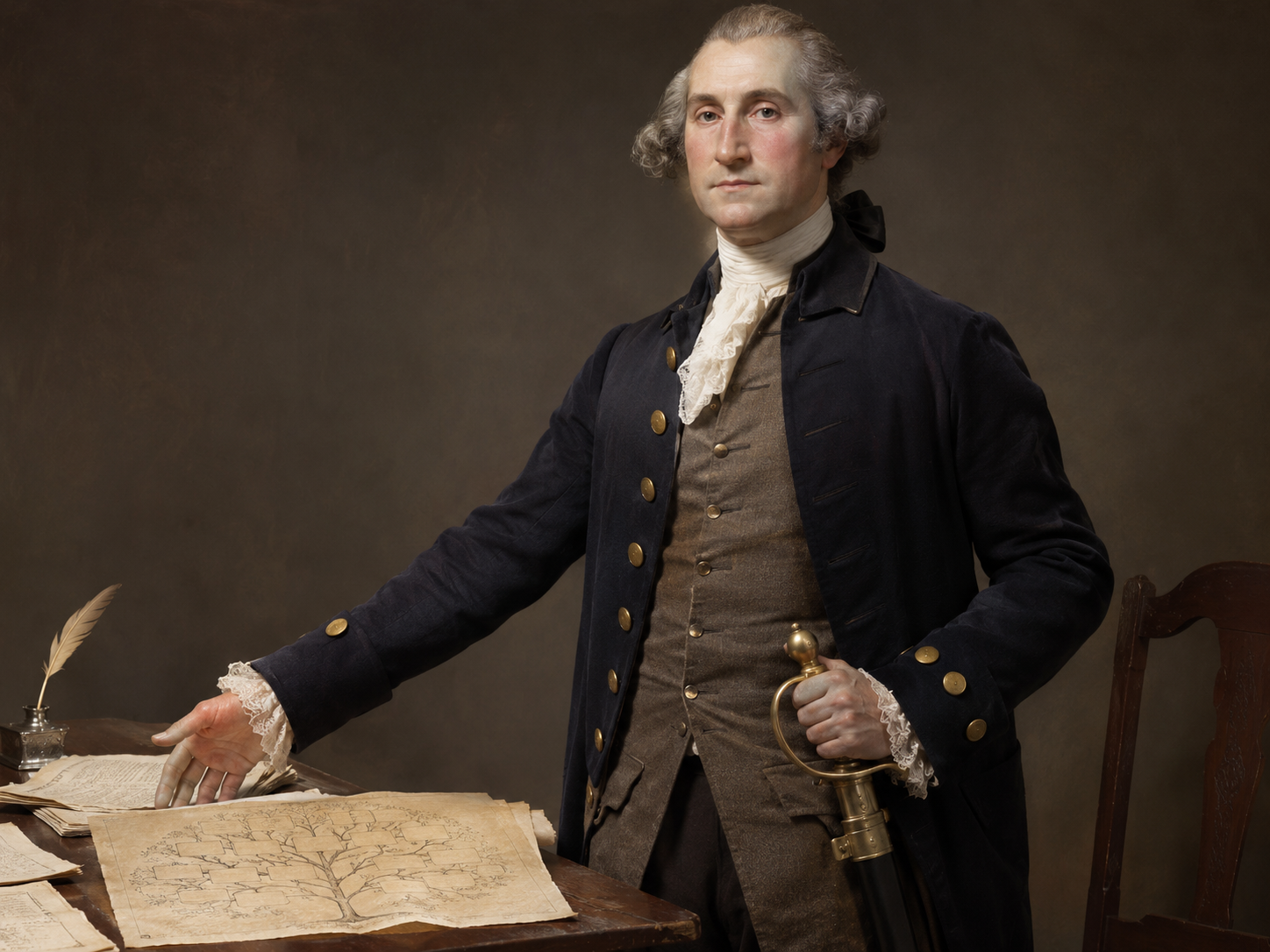
The first person recorded in Washington’s generation was his oldest brother, who had died in infancy years before Washington’s birth. According to the Library’s account, the entry indicates that the young Washington recognized the importance of identifying his father’s first-born son. The document also reflects what the Library described as a central contradiction in the American idea of freedom: On its reverse, Washington recorded a “List of Tithables,” referring to enslaved people he had inherited.
Alexander Hamilton likewise requested records of his ancestry in correspondence held by the Library, including details about a half-brother who left him a modest inheritance.
The Library noted that interest in family descent was not limited to the Founding Fathers.
Wulf said institutions made it practically necessary for people and families to know and provide genealogical details when conducting business. Family Bibles frequently served as repositories for those records because many contained spaces for documenting births, marriages, deaths and other major family events.
While people at society’s highest levels relied on genealogies to maintain claims to wealth and property, enslaved Americans needed evidence that they descended from free people to avoid being treated as property, the Library reported. Such evidence could also be recorded in a family Bible.
A Bible from the Rare Book and Special Collections Division’s Bible Collection, displayed during Wulf’s presentation, contained the names and birthdates of enslaved family members. Other records, however, conspicuously omitted some relationships. Wulf observed that every genealogy contains an element of fiction because following certain lines of descent while excluding others leaves out numerous relatives.
The Library’s post said that, from Colonial America through the Civil War and beyond, many genealogies deliberately disregarded important family ties across racial lines. One of the most widely discussed examples today involves Thomas Jefferson’s failure to acknowledge the six children he fathered with Sally Hemings, an enslaved woman at his estate. Jefferson freed the four children who reached adulthood, though two were freed only when he died, and none received an inheritance.
The Library holds early editions of sources used in Wulf’s research, among them a 1611 Bible containing elaborate illustrations of biblical genealogies. The presentation also featured John Eliot’s 1663 translation of the Bible into Massachuset, the language of an Indigenous people whose name was given to the state. According to the Library, Native genealogies also figured in colonists’ land and property disputes with Indigenous groups.
Wulf additionally consulted family genealogies and local histories, including a history of the Stebbins family and an early account of Scituate, Massachusetts. She said many of the first local histories originated as genealogies. Officials who maintained records of births, marriages and deaths often went on to write the earliest community histories from the perspective of the first known settlers and their descendants. Wulf refers to these works as “historio-genealogies.”
According to the Library, Blackstone’s “Commentaries on the Laws of England” was the leading legal text in 18th-century America. It was reprinted repeatedly during the 19th century and continues to be cited. Genealogy and family relationships are central to Blackstone’s treatment of property. The event displayed editions of Blackstone with detailed illustrations tracing how property passed through lines of descent.
“Genealogy is everywhere, in part,” Wulf said, “because it’s the law.”
Heraldry also occupied a prominent place in genealogy, extending back to the biblical illustrations of the 17th century. The Garter King of Arms at London’s College of Arms provided George Washington with a copy of the Washington coat of arms. The Library holds several richly illustrated volumes about heraldry dating to the very early 1800s. Wulf also noted that coats of arms remain visible on public buildings throughout the former 13 Colonies.
The Library said Wulf’s scholarship, particularly as presented in “Lineage,” demonstrates the foundational place genealogy held in the economy, society, culture and legal system of the territory that became the United States. The institution said that influence is documented throughout its collections.
Subscribe to the Library of Congress blog— it’s free!
Based on an article published by Library of Congress by Neely Tucker · Read the original ↗