The Library of Congress says its exploration of the early Americas encompasses jade pendants, the infant Jaguar god of the Underworld, empires, gold, silver, gods, art, books, temples, pyramids, Incas, Aztecs, Olmecs, Mayas, Taínos, Nahuas, maps, pictograms, Spanish, Portuguese, French, British, Dutch, Africans and vast new nations.
Those subjects represent only part of “Voices of the Early Americas,” a new permanent Library gallery in the Jefferson Building. According to the Library, the exhibition draws extensively from the Jay I. Kislak Collection of the Archaeology and History of the Early Americas, supplemented by rare books, maps, photographs and modern poetry held across the Library.
Primarily funded by the Kislak Family Foundation, the gallery is organized into four periods presented in roughly chronological order. The Library says it broadens and adds depth to an earlier Kislak exhibition, presenting a more expansive narrative that extends from roughly 3,000 years ago into the 21st century. Display screens rise overhead, an artifact wall presents many objects for the first time, and high-tech displays are intended to create an immersive experience of that history.
“In many respects, it’s a story that only the Library can tell,” says Matthew Robb, the Mesoamerican specialist in the Latin American, Caribbean, and European Division. “Only the Library has this kind of scope and scale of material from across all its divisions across all these eras.”
In the exhibition’s companion book, Robert R. Newlen, the acting Librarian of Congress, writes that “Voices” is designed to “spark conversations among the creators of these works, the sources they cited, the ideas they explored, the communities that continue to tell their stories today, and, importantly, our visitors and researchers.”
Kislak, a real-estate magnate and philanthropist based first in New Jersey and later in Florida, built his collection over five decades. In 2004, he made an initial donation of nearly 3,000 items to the Library. His collections of artifacts, documents, paintings, maps, charts, rare books and manuscripts represented more than a dozen Indigenous cultures from Mexico, the Caribbean and Central and South America.
A gold breastplate fashioned by a Coclé metalsmith some 1,200 years ago in present-day Panama. Rare Book and Special Collections Division. Photo: Collections Digitization Division.
Zapotec effigy urn made circa 500-600 in Oaxaca, Mexico. Rare Book and Special Collections Division. Photo: Collections Digitization Division.
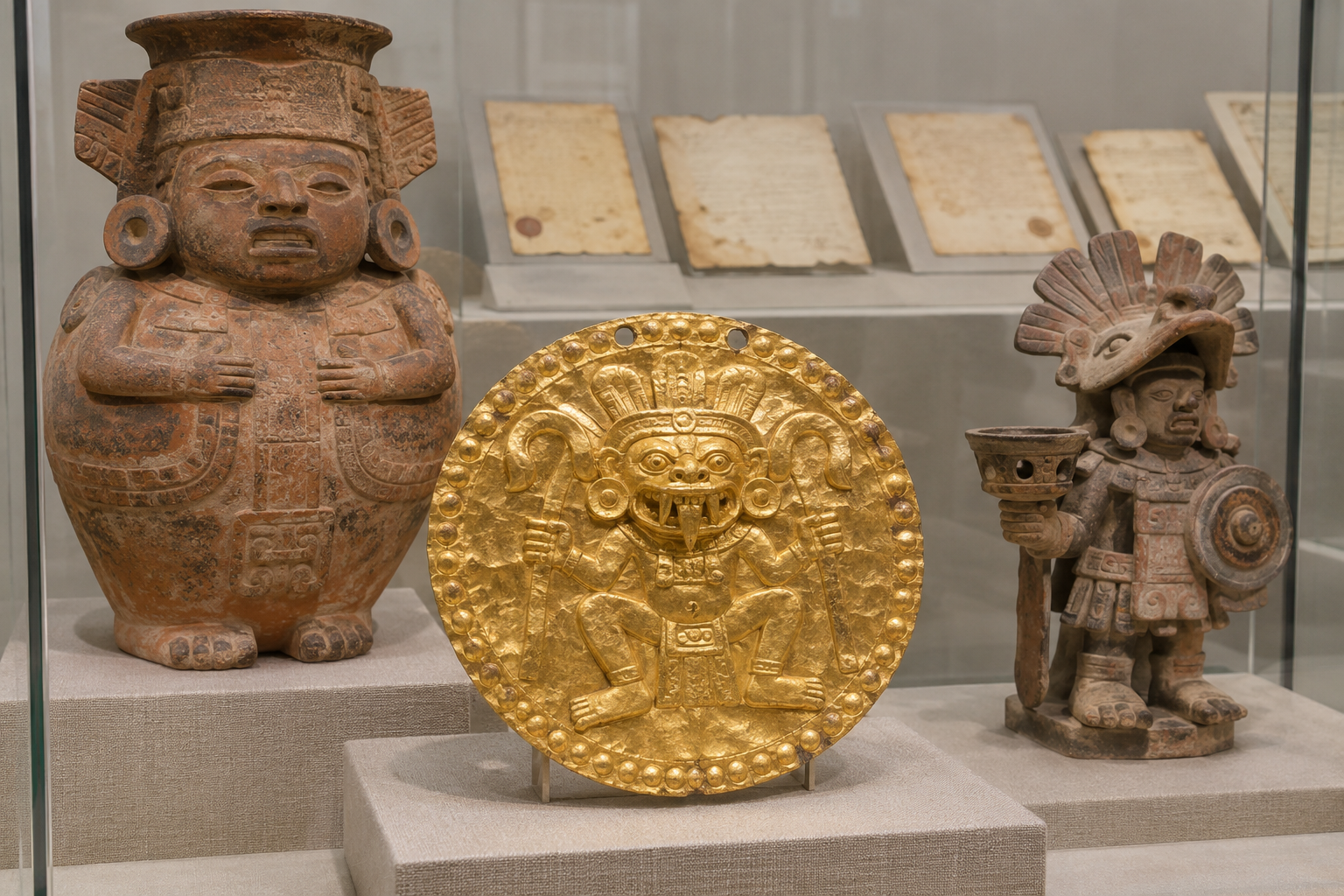
An Aztec incense burner in the form of a warrior, 1400-1500. Rare Book and Special Collections Division. Photo: Collections Digitization Division.
The post-contact world also figures prominently in both Kislak’s collection and the new gallery, including handwritten documents from King Philip II of Spain and Francisco Pizarro. Kislak collected material on Colonial America as well, among it George Washington’s 1762 diary and correspondence from Thomas Jefferson and John Quincy Adams.
The opening essay in the companion book says the gallery, considered as a whole, “reminds us that the cultural and political foundations of the Americas grew not from a single colonial origin, but from a complex convergence of peoples, empires, and worldviews.” The essay adds that the gallery “… helps reposition the history of what became the United States within a much deeper and more entangled hemispheric story.”
The Library presents that story through individually curated treasures and connections among cultures of the distant past. One of the gallery’s best-known objects is the Tortuguero Box, a small, intricately carved wooden Maya relic from southern Mexico.
The Library says the object’s specificity, viewed across the intervening centuries, gives power to this small piece of sapodilla wood, which is decorated with red hematite and holds a greenstone figure. Rather than being an anonymous carving, the object is associated with the name, date and title of a real person who held it on a particular day, in a particular place, 1,345 years ago. The Library describes it as offering a brief point of connection with his world.
The exhibition also follows wider intercultural stories unfolding over decades and centuries. Visitors can compare displays about the Taíno and life in the Caribbean with roughly contemporaneous materials relating to the Aztecs and other societies in modern Mexico.
“What are these civilizations like in which people in Tenochtitlan are in touch with people on the Gulf Coast?” Robb says. “And those folks on the Gulf Coast — Veracruz, Tabasco, what’s now the Yucatán — they’re in touch with people in the Caribbean. There’s a lot of trade, cultural exchange and some conflict.”
At the exhibition’s visual center are eight enormous “Conquest of Mexico” paintings that depict the Spanish conquest of the region in highly idealized terms. According to the Library, Europeans treated those works, painted by an unknown artist, and similar narratives as historical guideposts and shaped their histories around them.
Displayed beside the paintings are digital presentations of Indigenous accounts of the conquest. They convey stories from the Nahua people who survived it, whose most famous members are the Aztecs.
“This is the story that was being written in Tenochtitlan and in Tlatelolco (both covered by today’s Mexico City) in the 1550s and the 1560s,” Robb says. “This is the local history.”
The Library notes that these accounts do not tell the same stories as the paintings.
The Indigenous narratives come from a vast 16th-century manuscript now called the Florentine Codex. Franciscan friar Bernardino de Sahagún and several Nahua elders from across the community created the work. Written as parallel text in Nahuatl and Spanish, it includes more than 2,500 images and 12 books covering Nahua history, society and culture.
The final book recounts the Spanish conquest of Mexico and supplies numerous details that the conquistadors did not know and that do not appear in the paintings’ glorified presentation.
Spanish forces lay siege to Tenochtitlan in this late 17th-century painting by an unknown artist. Rare Book and Special Collections Division. Photo: Collections Digitization Division.
“… those who were conquered found out and gave account of many things that happened among them during the war, things that those who conquered did not know,” Sahagún wrote.
The Library highlights another distinction: Although the Spanish, and at times the Nahua, called the conquistadors “soldiers,” and later paintings immortalized them in that role, Robb characterizes the group differently.
“They were not soldiers as in trained military specialists, representatives of the Spanish crown as an army,” Robb said. “They were expeditioners. They were travelers, they were entrepreneurs, they were the second and the third sons of semi-important families in Spain. … There is this discrepancy when you start understanding just how kind of ragtag those guys actually were in comparison to how you see them presented later on in these paintings.”
The amount of history and material on display can become nearly overwhelming, the Library acknowledges.
The Library suggests pausing to examine a small ceramic male figurine. Seated with crossed legs, the cream-colored figure is shirtless and bald. Its creation is attributed to the Olmecs in Mexico around 3,000 years ago. Red coloring appears around its lips, nose and chin, while its arched eyes seem to squint or may be closed entirely.
The Library reflects on the figurine’s survival across that span of time: small and motionless, it was not left behind, broken or cracked, but instead passed through many hands, periods and places before arriving on display as what the Library describes as a talisman from a scarcely imaginable world.
The Library asks on what day the figurine was made, who created it and why. It also draws a connection to one of the exhibition’s most modern elements, a poem by Natalio Hernández. Born in Mexico in 1947, Hernández wrote the poem in Nahuatl, one of the region’s ancient languages. The Library suggests that its sentiments might also have been shared by the artisan who fashioned the figurine:
I will live each second of my life,
I will live an entire century;
I will live many centuries.
I will savor each word
and every single flower
I will relish each sunrise, each sunset.
I will work thinking of today,
of tomorrow and the day after tomorrow;
I will carve a path, my path, my destiny.
A jade pendant, a codex-style ceramic vessel and a French translation of a Spanish work on Mayan hieroglyphic writing. Rare Book and Special Collections Division. Photos: Collections Digitization Division.
Based on an article published by Library of Congress by Neely Tucker · Read the original ↗