UK GOV.UK has announced plans to embed dedicated time for reading for pleasure throughout primary and secondary education, alongside a new statutory reading check in Year 8.
Reading, including reading for enjoyment, is set to become a central pillar of what UK GOV.UK describes as the first major revision of the National Curriculum in a generation. The stated aim is to support every child in becoming a confident, fluent reader who develops a lifelong love of books.
Under plans due to be unveiled on Monday for the first new school curriculum in over a decade, schools will be expected to schedule regular time specifically for reading for pleasure. UK GOV.UK says this is intended to give every child, regardless of background, opportunities to explore a varied choice of books and other reading material they enjoy.
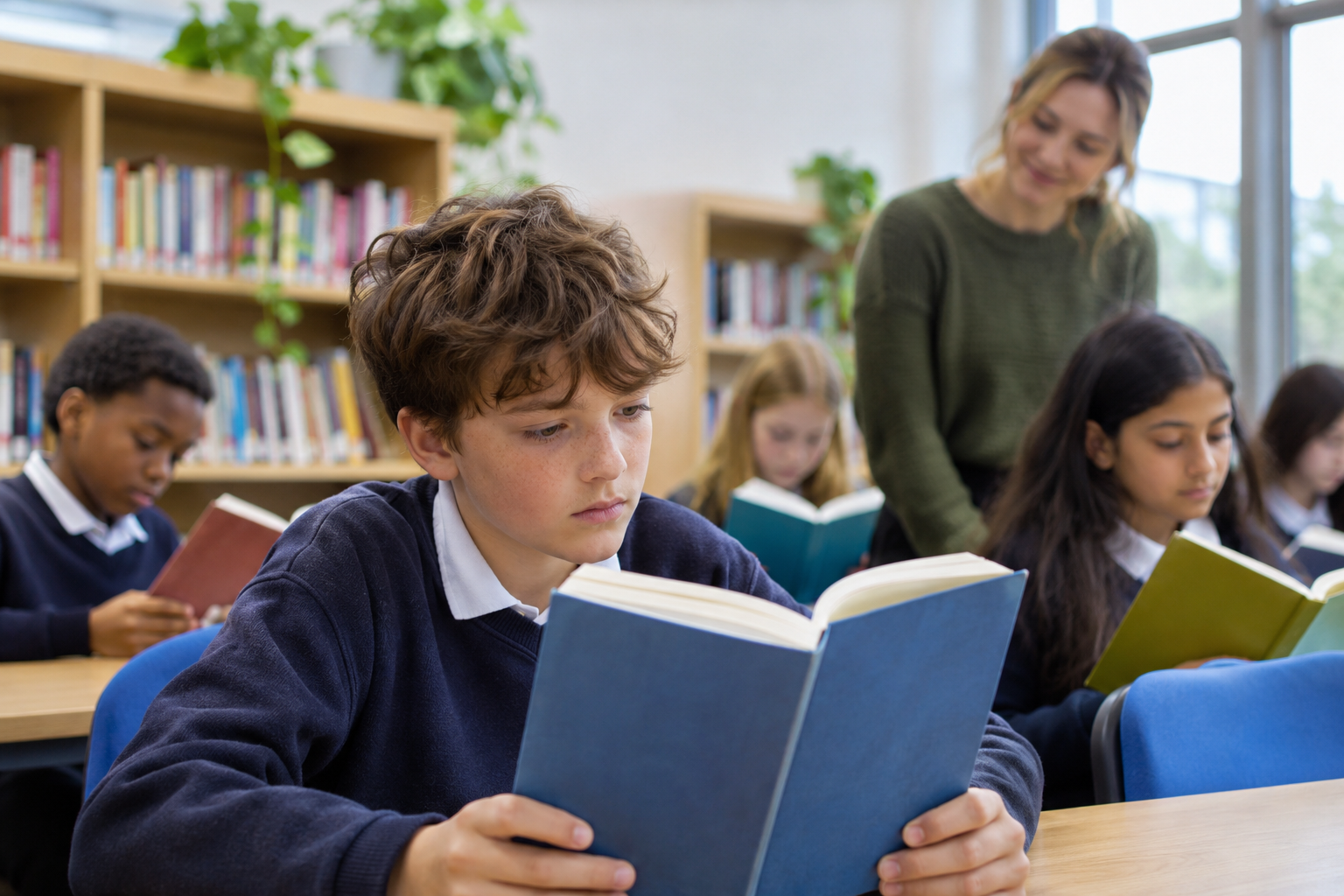
Primary schools will be expected to allocate curriculum time for reading every day. Secondary schools will have flexibility to give students regular reading time across the week, focusing on engagement with complete books, poems and other literature to help young people become independent readers.
The government also plans to introduce a statutory Year 8 reading check to identify pupils who require additional support and prevent them from continuing to slip through the cracks.
According to UK GOV.UK, enjoyment of reading and daily reading remain too limited amid competition for attention from mindless scrolling, with particularly low levels among disadvantaged children and boys.
As part of the curriculum reforms, the government says thousands more children will receive the reading foundations needed to thrive in education and later life. It has announced a target to halve the reading disadvantage gap by 2035 while increasing the overall proportion of pupils reaching the expected reading standard to at least 80%.
UK GOV.UK cited international PISA data indicating that progress has stagnated and described reading fluency as critical to children’s success and resilience in the digital age. It said this action, together with wider reforms to be announced in the coming days, would help develop the next generation of confident lifelong learners.
Ministers intend to build on the National Year of Reading, seeking a lasting cultural change that returns books to the centre of children’s lives in classrooms, homes, libraries and communities.
An additional £650,000 will be provided to turn the National Year of Reading from a one-year campaign into a permanent “National Reading Movement”.
In remarks published by UK GOV.UK, the government said: “Across the world, we are seeing a ticking time bomb for our future generations, as reading and literacy levels are falling with too many children seeing reading as a chore or missing out altogether.
We cannot afford to stand idly by and let this continue. Reading fluently is the gateway to lifelong learning, opening up every subject in school and creating opportunities throughout life.
Reading is not just a skill that sets children up for success throughout their lives. It’s an experience to be enjoyed, and every child should have the opportunity to discover that.
Through these reforms and the National Reading Movement, I’m determined to buck that trend, to make sure every child in this country can become confident, fluent readers, curious about the world, ready to keep learning throughout their lives.”
The National Year of Reading began in January of this year as a nationwide campaign intended to counter the decline in reading for pleasure and help every child embrace the enjoyment it can bring. UK GOV.UK said early indications provide grounds to build on, with reading enjoyment increasing in 2026 for the first time in five years and 7 million people reporting that the National Year of Reading had positively affected their reading habits.
Reading is intended to serve as a golden thread throughout the refreshed curriculum, reflecting what the government describes as its function as a gateway to learning in every subject and one of the strongest predictors of later educational success. The government also plans to build on the success it attributes to phonics, helping every child learn to decode before becoming a confident, fluent and independent reader.
UK GOV.UK said strong reading fluency remains one of the clearest indicators of future educational achievement because it helps children access the wider curriculum, expand their knowledge and develop the vocabulary, confidence and analytical abilities needed in education and later life.
Activities, events and resources offered through the National Year of Reading will continue, connecting children with leading authors and helping them find books and other material they enjoy reading.
By extending the work of the National Year of Reading, the government says it is helping schools make enjoyment of reading part of daily school life and encouraging children to engage with learning both across and beyond the curriculum.
The programme additionally gives schools practical resources and professional development intended to help teachers incorporate reading for pleasure throughout school life, in support of the wider ambition for a curriculum that encourages and inspires children to continue learning.
More than 2.2 million children have already participated in the programme, while over 7,000 schools and 11,000 teachers have registered to take part.
Michael Morpurgo, author, poet and playwright, said: “I am so thrilled that this initiative is happening, and would support it in any way that would help. I’ve been longing for storytime to be a regular part of every child’s life at school. And now it really might be.
From my time as a young teacher I realised that reading to children in school should be an essential part of the school day. And I discovered that the last half hour of the school day was best. Teachers and children were ready for a story. The school was hushed. For me and the children this was the time of the day most looked forward to. The effect on the children was quite evident, the intensity of the silence was all the evidence I needed. We did no comprehension. We just read a story. Then the bell rang and they went off home with the story in their heads.
Dedicated reading time is a wonderful step forward, but it’s equally important that children have access to books they can choose, enjoy and return to again and again. That’s why school libraries matter so much – they’re a place to discover books, to sit and read or write or dream. It should be the heart and soul of any school, a place dedicated to fostering a love of stories and poems, the place where knowledge and understanding can and does so often begins.”
Cressida Cowell, Children’s Author and Illustrator, said: “I am so pleased that the government is continuing its commitment to the Go All In Schools and Settings Programme into 2027.
As someone who has been going into schools and talking about books and reading for almost 25 years, I can say firsthand that children in schools with well-established literacy funding have a real, long-term advantage, and enable teachers to support every child to find books they love.
It’s wonderful that the government has acknowledged that reading for enjoyment is not an optional extra but an investment that will pay dividends to children personally and us all as a society for many years to come.”
Rebecca Sinclair, President of the Publishers Association and Chief Brand Officer of Penguin Random House UK, said: “We are delighted that the Government has recognised the positive impact of the National Year of Reading and committed to making reading a long-term priority.
As publishers, we see every day the extraordinary power of reading to create opportunity, build connection and bring joy. We will continue to engage in a myriad of ways including facilitating author engagement, mobilising our workforces, sharing expertise and providing funding.
But no one organisation or sector can reverse the decline in reading alone. By working together across government, publishing, schools, libraries, booksellers, charities, businesses and communities, we have a real opportunity to turn the momentum of this year into lasting change.
That is the ambition of The National Reading Movement - not simply to get more people reading today, but to build a culture in which reading becomes a lifelong habit, giving every child the opportunity to discover the joy of reading and all that it can unlock, while creating a more connected, empathetic, literate and analytical society.”
Based on a UK GOV.UK news release · Read the original ↗